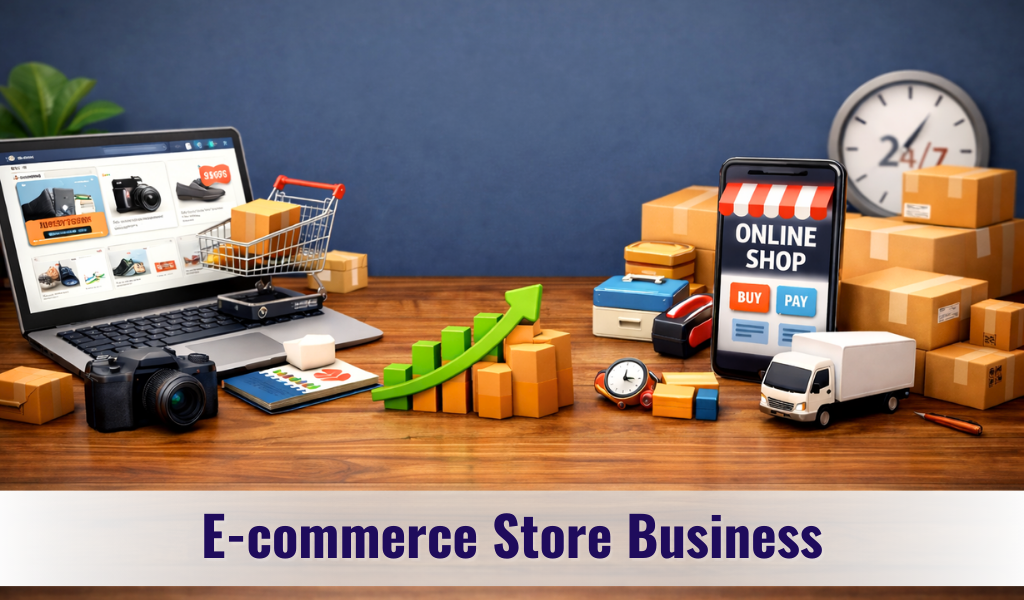
Starting an E-commerce Store Business in India is one of the most profitable and fastest-growing business opportunities today. With rising internet penetration, digital payments, and smartphone usage, online shopping has become a daily habit for millions of Indians. From fashion, electronics, groceries, beauty products, to digital goods — everything sells online.
An e-commerce business allows entrepreneurs to start from home with low investment, reach pan-India customers, and scale quickly with the right marketing strategies.
Business Overview – E-commerce Store Business Model
Parameter
Details
Business Category
Retail
Business Type
Trading
Initial Investment
₹2 – ₹5 Lakhs
Profit Margin
25% – 40%
Skills Required
Management, Marketing, Operations
Market Demand
Very High
Location Type
Home-Based
Licenses Required
GST Registration
What is an E-commerce Store Business?
An E-commerce Store is an online platform where products or services are sold digitally using websites, mobile apps, and online marketplaces. Customers browse products, place orders, make payments online, and receive home delivery.
India has over 850+ million internet users, making it one of the largest digital consumer markets globally.
2. Low Startup Cost
You can start from home with ₹2–5 lakhs.
3. High Scalability
You can expand from local to national and global markets easily.
4. 24×7 Sales Model
Your store works round-the-clock, increasing revenue potential.
5. Work from Anywhere
Complete location freedom and flexibility.
Types of E-commerce Business Models
1. Inventory-Based Model
You store and ship your own products.
2. Dropshipping Model
You sell products, but the supplier ships directly to customers.
3. Marketplace Selling
Selling through platforms like Amazon, Flipkart, Meesho.
4. D2C (Direct to Consumer) Model
You build your own brand and sell directly.
5. Subscription-Based Model
Monthly product or service subscriptions.
Investment Breakdown – ₹2 to ₹5 Lakhs
Expense Head
Estimated Cost (₹)
Website Development
20,000 – 60,000
Product Procurement
1,00,000 – 2,00,000
Digital Marketing
30,000 – 80,000
Logistics Setup
15,000 – 40,000
Software & Tools
10,000 – 30,000
Branding & Packaging
15,000 – 40,000
Total Investment
₹2 – ₹5 Lakhs
Profit Margin & Income Potential
Average Profit Margin:
👉 25% – 40%
Monthly Income Projection:
Monthly Sales
Profit @30%
₹1,00,000
₹30,000
₹3,00,000
₹90,000
₹5,00,000
₹1,50,000
₹10,00,000
₹3,00,000
With consistent marketing, profits can scale exponentially.
Step-by-Step Guide to Start an E-commerce Store in India
Step 1: Choose Profitable Niche
Popular niches:
Fashion & Apparel
Beauty & Personal Care
Electronics Accessories
Grocery & Organic Products
Home Decor
Baby Products
Fitness & Wellness
Step 2: Finalize Products & Suppliers
Local wholesalers
Manufacturers
Dropshipping suppliers
Importers
Step 3: Register Business & Legal Compliance
Mandatory:
GST Registration
Optional (Recommended):
Trade License
MSME Registration (Udyam)
Trademark Registration
Step 4: Build E-commerce Website
Platforms:
Shopify
WooCommerce (WordPress)
Wix
Magento
Essential Features:
Mobile responsive
Fast loading
Secure payment gateway
Easy checkout
Step 5: Payment Gateway Integration
Popular Gateways:
Razorpay
PayU
Cashfree
Paytm
PhonePe
Step 6: Logistics & Delivery Setup
Courier Partners:
Delhivery
Shiprocket
Bluedart
Ekart
India Post
Step 7: Launch & Marketing
SEO
Google Ads
Facebook & Instagram Ads
Influencer Marketing
WhatsApp Marketing
Email Campaigns
Licenses & Legal Requirements
License
Requirement
GST Registration
Mandatory
Business Registration
Proprietorship / LLP / Pvt Ltd
MSME Registration
Optional
Trademark
Optional
Payment Gateway KYC
Mandatory
Best Marketing Strategy for E-commerce Store
1. Search Engine Optimization (SEO)
Product page optimization
Blog content
Keyword targeting
2. Social Media Marketing
Instagram Reels
Facebook Ads
YouTube Shorts
3. Influencer Marketing
Micro-influencers
Product reviews
4. Performance Ads
Google Shopping Ads
Meta Ads
5. Retargeting Campaigns
Increase conversion rates
Top Mistakes to Avoid
Poor website speed
Low-quality product images
Weak customer support
Bad packaging
No return policy
High shipping charges
Future Scope of E-commerce Business in India
India’s e-commerce market is expected to cross $200 Billion by 2030, driven by:
Digital India initiatives
UPI adoption
Rural internet penetration
Quick commerce growth
This makes e-commerce one of the safest long-term businesses.
Advantages of E-commerce Store Business
✔ Low investment ✔ High scalability ✔ Global reach ✔ Flexible operations ✔ Automation possible ✔ Work-from-home model
Challenges in E-commerce Business
High competition
Customer acquisition cost
Returns & refunds
Logistics management
With proper strategy, these challenges can be turned into opportunities.
Conclusion
Starting an E-commerce Store Business in India is a high-growth, scalable and future-proof business opportunity. With ₹2–5 lakhs investment, smart product selection, strong marketing, and customer-focused service, entrepreneurs can build highly profitable online brands.

If executed properly, this business can generate consistent monthly income and long-term brand value.